What Developers Think OpenShift Does vs. What It Actually Does
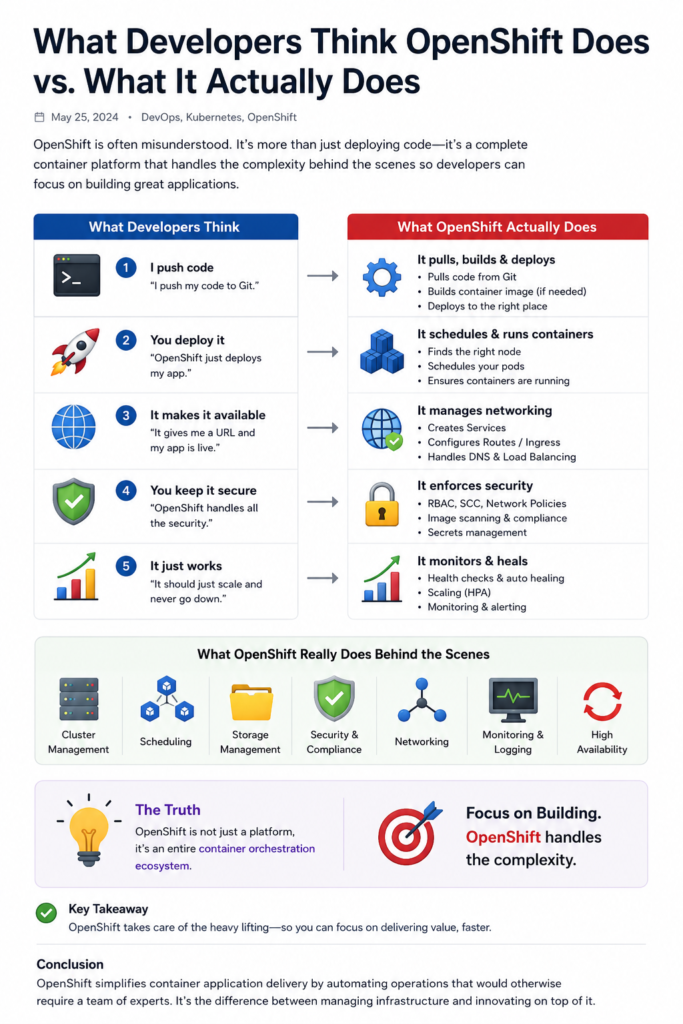
When developers first start using OpenShift, it’s easy to think it’s just a platform for deploying applications. In reality, OpenShift is much more than that. It automates many operational tasks so developers can focus on writing code instead of managing infrastructure.
Common Misconceptions
Many developers believe the workflow looks like this:
- Push code to Git
- Deploy the application
- Get a public URL
- Security is handled automatically
- Everything scales on its own
While these statements are partially true, they only describe the outcome—not the work happening behind the scenes.
What OpenShift Actually Does
OpenShift performs multiple automated tasks throughout the application lifecycle.
1. Builds and Deploys Applications
After code is pushed to Git, OpenShift can:
- Build a container image
- Store the image in a registry
- Deploy the application automatically
This creates a faster and more consistent deployment process.
2. Schedules Containers
OpenShift uses Kubernetes to determine where containers should run.
It automatically:
- Selects the best worker node
- Starts application pods
- Restarts failed containers
- Maintains the desired application state
3. Manages Networking
OpenShift makes applications accessible by configuring networking resources such as:
- Services
- Routes or Ingress
- Internal DNS
- Load balancing
Developers don’t have to manually configure these components.
4. Improves Security
Security is built into the platform.
OpenShift helps by:
- Managing user permissions (RBAC)
- Enforcing security policies
- Protecting secrets and credentials
- Scanning container images
This reduces security risks while following best practices.
5. Monitors and Heals Applications
OpenShift continuously monitors running workloads.
It can:
- Perform health checks
- Restart unhealthy containers
- Automatically scale applications
- Collect logs and metrics
This improves application reliability and availability.
Behind the Scenes
OpenShift also manages several infrastructure components that developers rarely see:
- Cluster management
- Kubernetes scheduling
- Storage provisioning
- Networking
- Monitoring and logging
- Security and compliance
- High availability
All of these work together to keep applications running smoothly.
Key Takeaway
OpenShift is more than a deployment platform. It is a complete Kubernetes application platform that automates deployment, networking, security, scaling, monitoring, and operations.
Instead of spending time managing infrastructure, developers can focus on building and delivering applications.
Conclusion
OpenShift simplifies the entire application lifecycle by handling much of the operational complexity automatically. Whether you’re deploying a small web service or a large enterprise application, OpenShift provides the tools needed to build, deploy, secure, and scale applications efficiently. That’s why it’s considered a complete container platform rather than just a deployment tool.