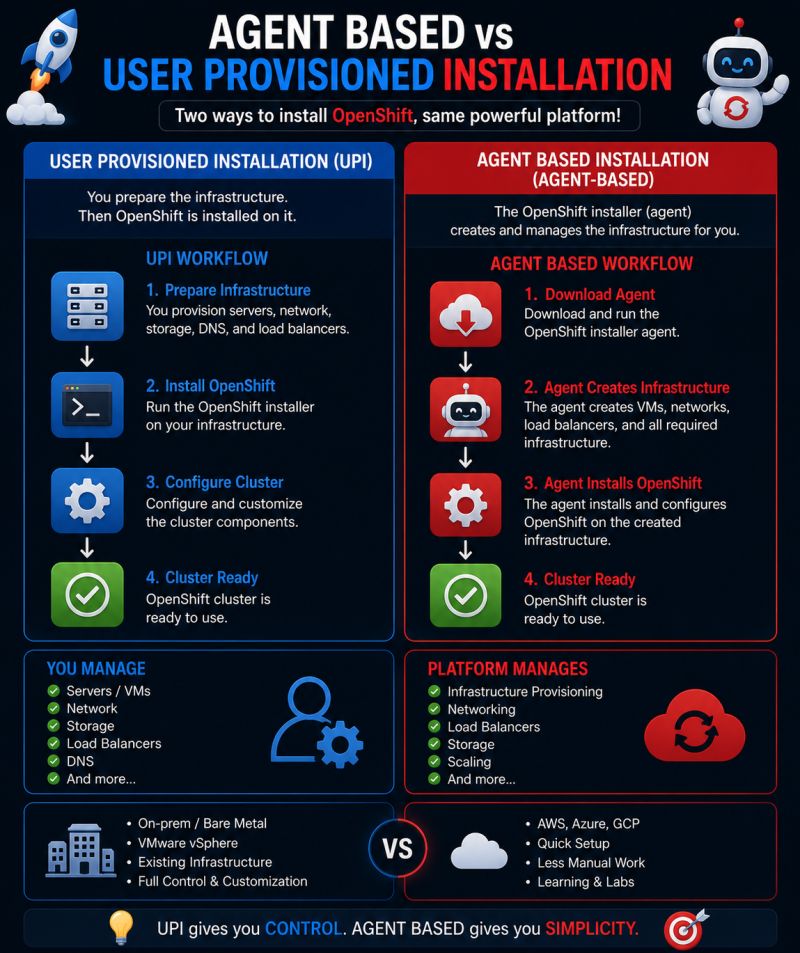
🚀 OpenShift Installation: Agent-Based vs UPI — What’s the Real Difference?
One of the most common misconceptions among people learning OpenShift is that Agent-Based Installation and User-Provisioned Infrastructure (UPI) are completely different installation methods.
They’re not.
Both methods install the same OpenShift cluster.
The real difference lies in who is responsible for preparing the infrastructure and orchestrating the installation.
Understanding the Two Approaches
Both installation methods follow the same goal:
✅ Deploy a fully functional OpenShift cluster.
The difference is in the amount of automation involved.
User-Provisioned Infrastructure (UPI)
With UPI, the infrastructure team is responsible for preparing everything before OpenShift installation begins.
This includes:
- 🖥️ Provisioning servers or virtual machines
- 🌐 Configuring networking (VLANs, routing, gateways)
- 📡 Setting up DNS records
- ⚖️ Configuring API and Ingress load balancers
- 💾 Preparing storage infrastructure
- 🔐 Configuring firewall rules and network access
Only after the infrastructure is fully prepared does the OpenShift installation begin.
UPI Workflow
Prepare Infrastructure
        │
        ▼
Configure DNS & Networking
        │
        ▼
Configure Load Balancer
        │
        ▼
Generate Installation Assets
        │
        ▼
Boot Cluster Nodes
        │
        ▼
Install OpenShift
        │
        ▼
✅ Cluster Ready
Advantages
- Full control over infrastructure
- Ideal for enterprise environments with existing standards
- Supports advanced networking and security requirements
- Easy integration with existing datacenter automation
Challenges
- More manual preparation
- Greater operational complexity
- Longer deployment time
- Requires deeper infrastructure knowledge
Agent-Based Installation
Agent-Based Installation simplifies cluster deployment by automating much of the bootstrap process.
Instead of manually orchestrating every installation step, you:
- Generate an Agent ISO.
- Boot each server from the ISO.
- The agents automatically discover one another.
- The installer validates the hosts and forms the cluster.
- OpenShift is installed with minimal manual intervention.
Agent-Based Workflow
Generate Agent ISO
        │
        ▼
Boot All Servers
        │
        ▼
Agents Discover Hosts
        │
        ▼
Validate Hardware & Networking
        │
        ▼
Automatic Cluster Installation
        │
        ▼
✅ Cluster Ready
Because the discovery process is automated, administrators spend significantly less time coordinating the installation.
What Happens Behind the Scenes?
When a node boots using the Agent ISO:
- The host starts the OpenShift Agent.
- Hardware information is collected.
- Network connectivity is verified.
- The node registers with Assisted Service.
- All participating hosts discover each other.
- Installation begins once the required control plane and worker nodes are available.
This automation reduces many of the manual tasks traditionally associated with cluster deployment.
Architecture Comparison
                 User-Provisioned Infrastructure (UPI)

 Administrator
      │
      ▼
Prepare Infrastructure
      │
      ▼
Configure DNS / Load Balancer / Network
      │
      ▼
Boot Nodes
      │
      ▼
OpenShift Installation
      │
      ▼
Running Cluster
               Agent-Based Installation

Administrator
      │
      ▼
Generate Agent ISO
      │
      ▼
Boot Servers
      │
      ▼
Automatic Host Discovery
      │
      ▼
Cluster Installation
      │
      ▼
Running Cluster
Feature Comparison
| Feature | UPI | Agent-Based |
|---|---|---|
| Infrastructure preparation | Manual | Mostly automated |
| Host discovery | Manual | Automatic |
| Installation complexity | Higher | Lower |
| Deployment speed | Slower | Faster |
| Enterprise customization | Excellent | Good |
| Bare metal deployments | Excellent | Excellent |
| Edge deployments | Possible | Excellent |
| Lab environments | Good | Excellent |
Real-World Analogy
Imagine building a house.
🏗️ UPI
You purchase the land, arrange utilities, hire contractors, supervise construction, and coordinate every phase yourself.
You have complete control over every detail—but you’re also responsible for every step.
🏡 Agent-Based Installation
You start with a well-designed modular home kit.
The installation team follows an automated, predefined process that assembles the house quickly and consistently.
You still own the house—but much of the construction effort has been streamlined.
When Should You Choose Each?
Choose UPI when:
- ✅ Your organization has strict infrastructure standards.
- ✅ You need advanced networking or custom integrations.
- ✅ Existing enterprise load balancers and DNS services must be reused.
- ✅ Maximum flexibility and control are required.
Choose Agent-Based Installation when:
- ✅ You want faster deployments.
- ✅ You’re deploying on supported bare-metal hardware.
- ✅ You’re building edge or remote site clusters.
- ✅ You want a simpler installation experience with fewer manual steps.
- ✅ You’re creating lab, development, or production clusters where automation is preferred.
Key Takeaway
Agent-Based Installation and UPI both deploy the same OpenShift platform.
The difference isn’t what gets installed—it’s how the installation is orchestrated.
- UPI gives administrators complete control by requiring manual infrastructure preparation before installation.
- Agent-Based Installation automates host discovery and much of the deployment workflow, reducing operational effort and accelerating cluster creation.
As organizations increasingly adopt edge computing and automated infrastructure, Agent-Based Installation has become a popular choice for modern OpenShift deployments, while UPI remains the preferred option for environments that require deep infrastructure customization.
💡 Interview Question
What’s the biggest difference between UPI and Agent-Based Installation?
Answer:
User-Provisioned Infrastructure (UPI) requires administrators to manually prepare and manage infrastructure components such as networking, DNS, load balancers, and servers before installing OpenShift.
Agent-Based Installation uses bootable Agent ISOs that automatically discover participating hosts, validate the environment, and coordinate the installation, significantly reducing manual effort while deploying the same OpenShift cluster.