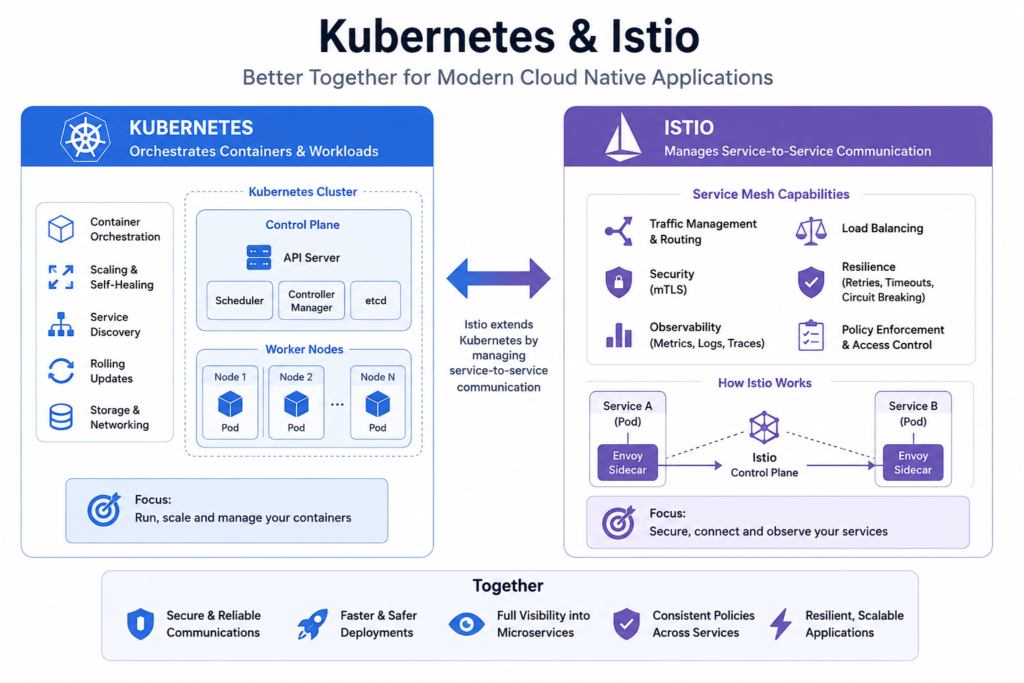
As organizations adopt microservices, Kubernetes makes it easy to deploy and manage containers at scale. However, as the number of services grows, managing communication between them becomes increasingly challenging. Ensuring secure, reliable, and observable interactions across dozens or even hundreds of services requires more than Kubernetes alone.
This is where a Service Mesh comes into play.
In this article, we’ll explore what a Service Mesh is, how Istio works, and why it’s an essential component for modern Kubernetes environments.
What is a Service Mesh?
A Service Mesh is an infrastructure layer that manages communication between services in a Kubernetes cluster.
Instead of embedding networking logic inside your applications, a Service Mesh handles these responsibilities transparently, allowing developers to focus on business logic while the platform manages service communication.
A Service Mesh provides capabilities such as:
Intelligent traffic management and routing
Built-in load balancing
Automatic service discovery
Mutual TLS (mTLS) encryption
Observability through metrics, logs, and distributed tracing
Resilience features like retries, timeouts, and circuit breakers
These features help improve the reliability, security, and operational visibility of microservices.
Why Kubernetes Alone Isn’t Enough
Kubernetes excels at orchestrating containers, but it doesn’t provide advanced service communication features out of the box.
For example, Kubernetes can:
Schedule and run containers
Scale applications
Perform rolling updates
Manage networking and service discovery
However, if you need advanced capabilities such as:
Canary deployments
Traffic splitting
Mutual TLS between services
Fine-grained traffic policies
Distributed tracing
Automatic retries and fault handling
You’ll need an additional layer—and that’s exactly what a Service Mesh provides.
What is Istio?
Istio is one of the most widely used Service Mesh implementations for Kubernetes.
It extends Kubernetes by adding a powerful networking layer that manages communication between services without requiring changes to application code.
Instead of modifying your applications, Istio injects Envoy sidecar proxies alongside each application pod.
Every request entering or leaving a service passes through the Envoy proxy, allowing Istio to apply networking, security, and observability policies consistently across the cluster.
Since every request flows through the Envoy proxies, Istio can monitor, secure, and control traffic without modifying the application itself.
Key Features of Istio
Intelligent Traffic Management
Istio allows platform teams to control how traffic flows between services.
Common use cases include:
Canary deployments
Blue-Green deployments
A/B testing
Traffic mirroring
Request routing based on headers or user attributes
This enables safer application releases with minimal risk.
Built-in Security with mTLS
Security is a major advantage of Istio.
It can automatically encrypt communication between services using Mutual TLS (mTLS).
Benefits include:
Encrypted service-to-service communication
Automatic certificate management
Service identity verification
Zero Trust networking
Applications remain unchanged while communication becomes significantly more secure.
Observability
Understanding what’s happening inside a microservices environment can be difficult.
Istio provides rich observability by collecting:
Metrics
Logs
Distributed traces
These insights integrate with tools like:
Prometheus
Grafana
Jaeger
Kiali
This makes troubleshooting and performance analysis much easier.
Resilience
Distributed systems experience failures, but Istio helps applications recover gracefully.
Built-in resilience features include:
Automatic retries
Request timeouts
Circuit breaking
Fault injection for testing
Rate limiting
These capabilities improve application stability and user experience.
Kubernetes vs Service Mesh vs Istio
Component
Primary Responsibility
Kubernetes
Orchestrates containers, pods, and workloads
Service Mesh
Manages service-to-service communication
Istio
Implements a Service Mesh using Envoy proxies
Think of it this way:
Kubernetes manages where applications run.
Service Mesh manages how applications communicate.
Istio provides the tools and infrastructure to implement that communication securely and reliably.
When Should You Use Istio?
Istio is especially valuable when your Kubernetes environment includes:
Many microservices
Multiple development teams
Strict security requirements
Complex traffic management needs
High availability requirements
Advanced monitoring and observability goals
For smaller applications with only a few services, Kubernetes networking may be sufficient. As your architecture grows, Istio becomes increasingly beneficial.
Benefits of Using Istio
By adopting Istio, organizations gain:
Centralized traffic management
Stronger security with automatic mTLS
Improved observability and troubleshooting
Better fault tolerance and resilience
Safer application deployments
Consistent networking policies across services
These capabilities reduce operational complexity while improving platform reliability.
Conclusion
Kubernetes provides a powerful platform for deploying and managing containerized applications, but it doesn’t address every challenge of microservice communication. A Service Mesh fills this gap by adding a dedicated layer for secure, reliable, and observable service-to-service networking.
Among the available Service Mesh solutions, Istio stands out as one of the most mature and feature-rich implementations. By leveraging Envoy sidecar proxies, Istio enables advanced traffic management, security, observability, and resilience—without requiring changes to application code.
As your Kubernetes environment grows, adopting Istio can simplify operations, strengthen security, and provide greater control over how your services communicate.
Key Takeaway: Kubernetes orchestrates your workloads, while Istio ensures those workloads communicate securely, reliably, and efficiently through a powerful Service Mesh.